Export
From Main Menu → Export you can output documents for manufacturing your harness, or save a local copy of your harness as a .harness file.
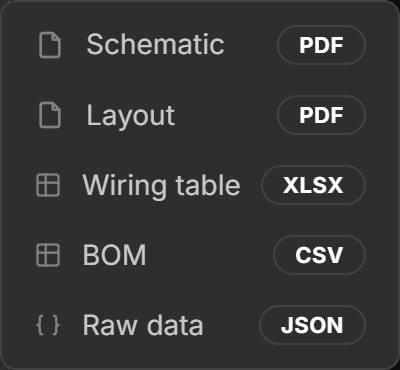
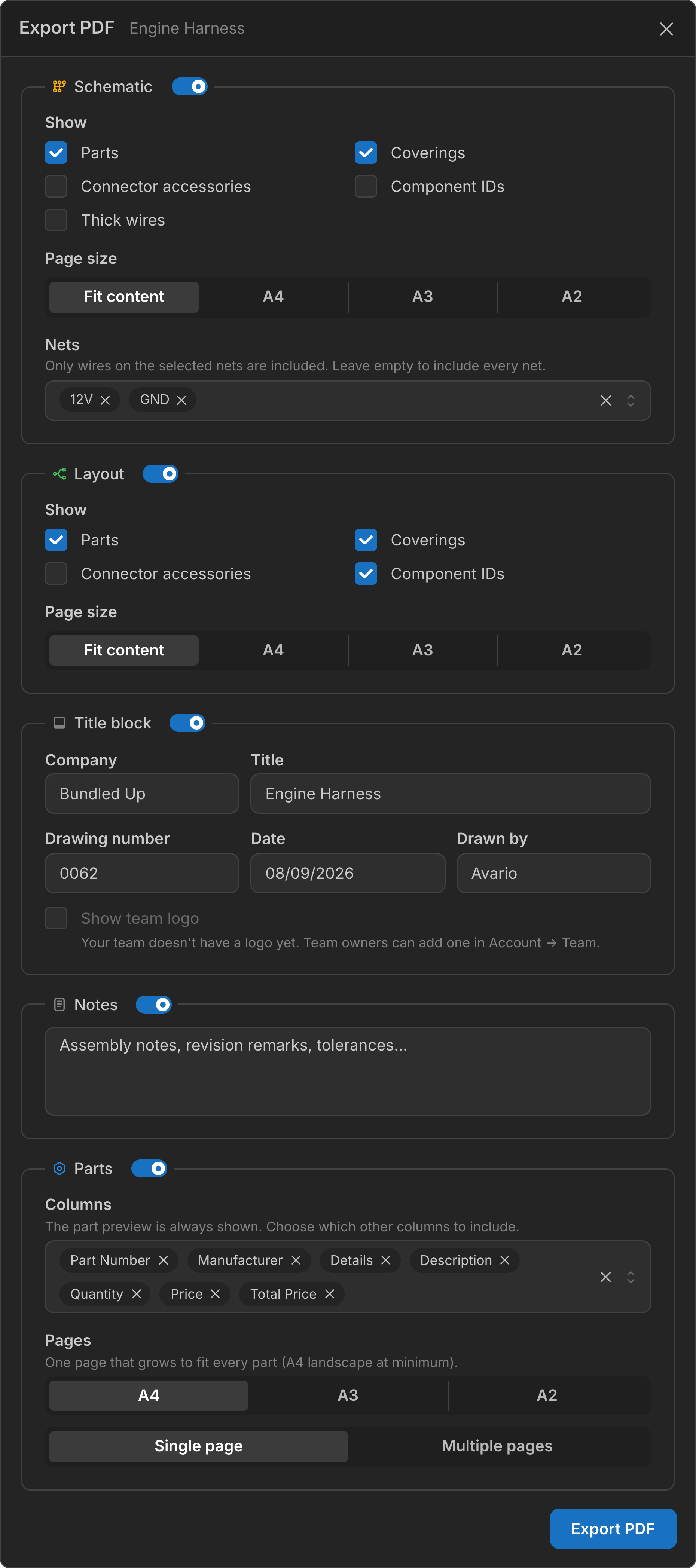
Opens the Export PDF panel, where you choose the content of the PDF before exporting. The export can contain a Schematic page, a Layout page, a Parts page and Connections pages, in any combination, each with its own options. A title block and notes can be added to every page.
Your setup is saved with the harness, so the next export starts from the same configuration.
Schematic
Includes a PDF page of the Schematic view, with these options:
- Show - Choose what is drawn on the page: Parts (the part pills assigned to components, including the coverings on bundles and the boots and coverings on branch points), Accessories (the accessory pills from each component’s configuration, such as locks, boots and coverings), Component IDs (
C1,W3, … on nodes; component labels are always drawn), and Thick wires (a heavier line weight for wires, cable cores and twisted wires). - Page size - Fit content sizes the page to the drawing. The ISO sizes A4, A3 and A2, and the US sizes Letter, Tabloid and ANSI C, give a fixed landscape page; the drawing is scaled down to fit if needed, never enlarged, and centred on the page. The title, notes and title block keep their size either way.
- Nets - Limit the page to specific nets. Only wires on the selected nets are drawn, and components that are not on a selected net are left out entirely. Cavity labels inherited from a hidden net still render, in a lighter gray. The shown nets are listed in the corner of the page.
Layout
Includes a PDF page of the Layout view, with the same Show and Page size options as the Schematic page.
For a formboard harness, the Layout page renders the whole formboard onto a single 1:1 scale page.
If inline components are hidden in the Layout view, splices, diodes and resistors are left off the Layout page too.
Connectors are drawn as they are on the canvas: as their to-scale top or side drawings when the harness’s Layout settings ask for them and the part has drawings, otherwise as the connector symbol. The Formboard Panels export draws them the same way.
Bundles, terminals and branch points also follow the harness’s Layout settings, on the Layout page and the Formboard Panels alike: bundles are drawn at their estimated thickness with their outermost covering or their wires along them (in colour, or grey with Draw coverings and wires in colour off), and connectors, terminal sleeves and branch points take their part colours with Draw components in their part colour on. Bundle length and covering labels sit clear of the thicker bundles.
Title block
Adds an engineering-drawing title block to the bottom-right corner of each page, with Company, Title, Drawing number, Date, and Drawn by fields. Only the fields you fill in are rendered.
Some fields fall back to a default when left empty:
- Title - The harness title.
- Date - Today’s date.
- Drawn by - The name on your profile.
Show team logo adds your team’s logo to the title block. Team owners can upload a logo from Account → Team.
The title block content is saved with the harness.
Notes
Adds free-text notes to the bottom-left corner of each page: assembly instructions, revision remarks, tolerances, or anything else the builder should read alongside the drawing.
The notes are saved with the harness.
Parts
Includes a bill of materials as a PDF page, sectioned by part type like the Parts view, with a total row at the bottom.
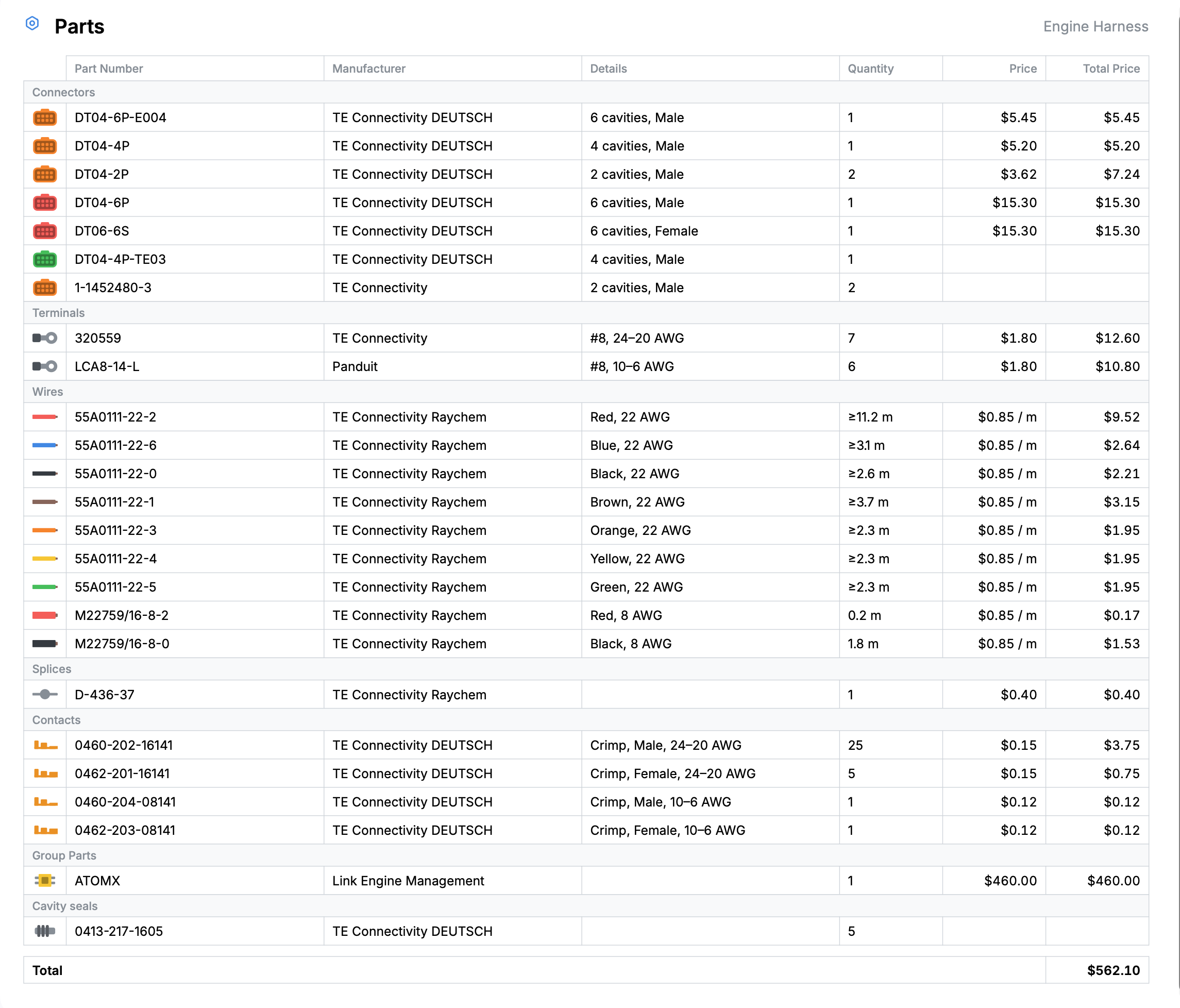
- Columns - Choose which columns to include: Part Number, Manufacturer, Details, Description, URL, Quantity, Price and Total Price. Every column except URL is included by default. The part preview column is always shown, and the selected columns share the page width. Part URLs are clickable links in the PDF.
- Pages - The page size, A4, A3, A2, Letter, Tabloid or ANSI C landscape, and whether the table is drawn as a Single page that grows to fit every part, or split across Multiple pages of that size.
Like the BOM, the Parts page lists the parts of this harness only. Parts inside an embedded harness are not included.
Connections
Includes wiring tables as PDF pages, with the same content as the Wiring table export, laid out like the Connections view. Choose either or both of:
- All connections - One table of every connection in the harness: the conductor (its colour and gauge), its part number, where each end lands (From and To), what it’s twisted with, its ident, group, net and routed length. Connections inside an embedded harness are listed in a section of their own at the end.
- Each component - Every connector, terminal, splice, diode and resistor, with its details and a table of that component’s own connections. Each row is one cavity (or side), with the conductor connected there and its Destination, the other end of the conductor. A cavity with more than one conductor spans several rows.
The options are:
- Columns - Choose which columns to include: Conductor, Part Number, Twisted With, Ident, Group, Net, Length and Contacts. The conductor preview and where each end connects are always shown. Contacts are shown in the component tables, in a column for the contact (or, for an empty cavity, the cavity plug) loaded in each cavity, followed by its cavity seal.
- Show conductor IDs - Adds each conductor’s ID (
W1,CB1.2) before its colour in the Conductor column. With IDs shown, Twisted With lists the other conductors by ID; without, by colour. - Components show - What each component shows above its table: the Part (part number, manufacturer, description and configuration), the Part image (when the part has one), the Accessories (the locks, boots, coverings and other accessories of the component’s configuration), the connector’s Pinout, and whether the table includes Unconnected cavities.
- Pages - The page size, A4, A3, A2, Letter, Tabloid or ANSI C landscape, and the layout. Single page stacks every table, the table of all connections and each component’s details and table, on one page that grows to fit them all. Multiple pages starts each table on a new page of that size, splitting it across more pages as needed, so a component with many connections can still run over several pages.
Only this harness’s own components are included. Components inside an embedded harness don’t get a table of their own.
Formboard Panels
Available for a formboard harness. Exports a PDF with one page per panel of the formboard grid, each page sized to your panel size and drawn to scale.
Print the pages, lay them out in the same grid arrangement, and build the harness directly on top. For example, an A3 panel with a 2 × 4 grid prints as 8 to-scale A3 pages.
The number of pages equals the Rows × Columns set under the formboard’s Panel grid settings.
Wiring table
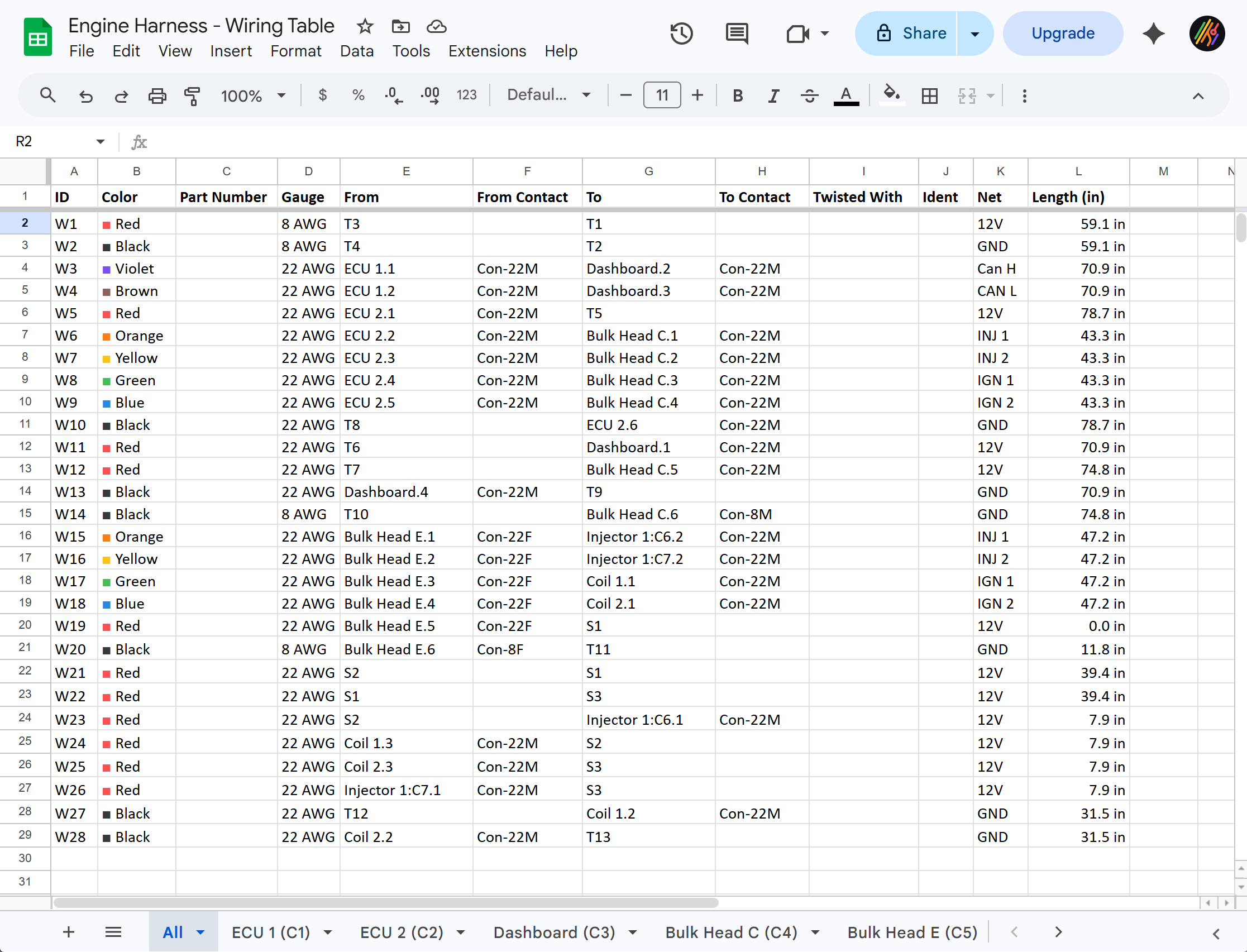
Exports an Excel .xlsx file based on the Connections view. The file contains a complete list of all connections, followed by individual sheets that break down connections per connector. Both list the contact and cavity seal in each connector cavity, in separate columns.
BOM
Exports a CSV version of the Parts view, including each part’s URL.
Local File
Saves the harness to your computer as a .harness file. The file contains all of the harness data, and it is the same format the Desktop App uses for local files.
See Local Files for how to open it again, and the JSON Format reference for what is inside.
Formboard Data
Available for a formboard harness. Exports a JSON file with everything needed to render the harness on a digital formboard, such as a projection based system, instead of printed panels.
The file contains the full formboard at physical scale: the panel configuration and pixel-to-length scale factor, every component with its position, rotation, and dimensions, the routed path of every bundle and wire, plus nets, coverings, notes, dimensions, and the part catalog. All geometry is relative to the top-left corner of the panel grid, matching the Formboard Panels PDF.
The file is also a complete Local File: the formboard payload sits under a single formboardData key alongside the harness data, so it can be opened as a harness like any .harness file (see Local Files). Formboard systems read formboardData and ignore the rest.